0161 531 1141 hello@bhl.direct
Mon-Fri 8:00 AM - 5:00 PM
BHL Underfloor Heating Ltd
0161 531 1141Request Estimate

Cheshire's Specialist UFH Service

Retrofit Floor Milling forUnderfloor HeatingAcross Cheshire.

Install full wet underfloor heating into your existing concrete or screed without lifting the floor, displacing the family, or rebuilding the property. Engineered, dust-extracted, and commissioned in 1–5 working days for a typical Cheshire home (most jobs land in 2–3 days), pay nothing until the system runs.

Rated 5.0 on Google · 5+ years specialist trading

Request a free quote

Tell us about your project

5+ Yrs
Specialist Trading
5.0 ★
Google Rated
MCS
Accredited Installer
1–5 Days
Typical Install

Overview

Underfloor heating retrofitted into the floor you already have.

Existing concrete Existing screed Occupied homes Period properties MCS-certified install

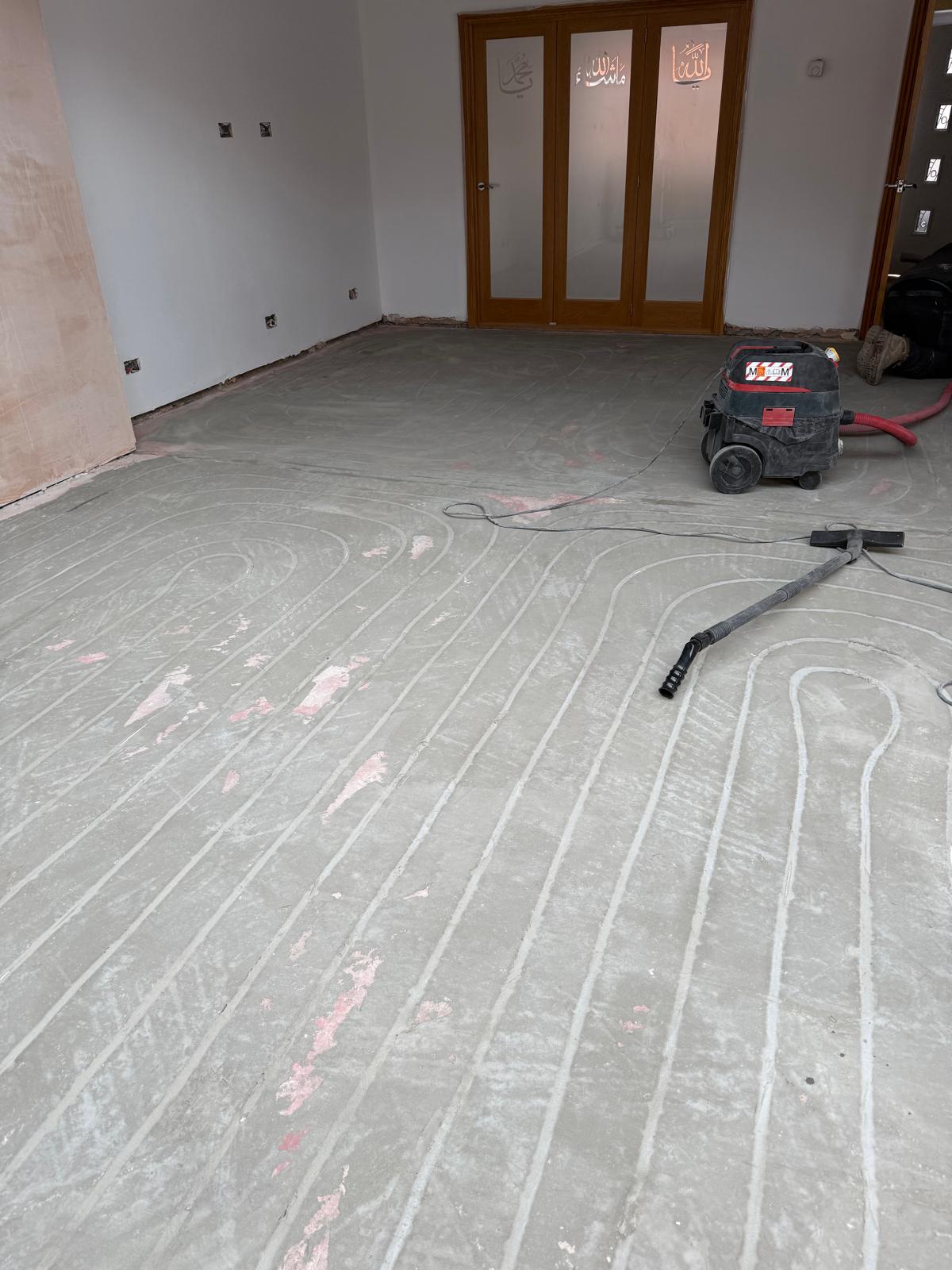
Retrofit floor milling is a precision technique that uses purpose-built routing machinery to cut shallow, dust-extracted channels directly into your existing concrete or screed. We then bed warm-water pipework into those channels, encapsulate them with thermally conductive compound, and commission a full hydronic underfloor heating system, without removing floors, raising thresholds, or rebuilding the property.

It is the right choice for Cheshire homeowners with solid floors who want the comfort and efficiency of a wet UFH system but cannot accept the disruption, cost, or floor build-up of traditional installation methods. We routinely deliver this on occupied family homes, listed Edwardian and Victorian conversions in Alderley Edge and Prestbury, and high-spec barn conversions where the original flagstone or polished concrete must stay.

You should be thinking about milling whenever you are replacing flooring, removing storage heaters or oil boilers, switching to an air source heat pump (heat pumps need low-temperature emitters to be efficient), or simply tired of inconsistent radiator heat in larger ground-floor rooms. Done badly, retrofit UFH is an expensive disappointment, pipes too sparse, screed too thick, controls a mess. Done by a specialist team, it is genuinely indistinguishable from a new-build system, and lasts the same 50+ year design life.

The Cost of Getting It Wrong

Cheap milling is more expensive than no milling.

Floor milling looks simple in a marketing video. In practice, every metre cut into a structural floor is irreversible. A poorly planned retrofit can leave you with cold spots, blown floor coverings, voided heat-pump grants, and, in the worst cases, a structural slab that has to be poured again from scratch.

Cold spots & uneven heat

Pipes spaced for a generic 200 mm pitch on a high-loss room (large glazing, exposed gables, suspended timber above) will under-deliver. You get a system that costs the same to run as radiators and warms nothing.

Cracked or lifted finishes

Channels milled too close to the slab edge, run unencapsulated, or commissioned without a proper cure cycle pop tiles, lift LVT, and warp engineered boards. We have re-engineered other firms' jobs from scratch.

Voided heat-pump efficiency

An air source heat pump paired with the wrong flow temperature or pipe layout drops out of its efficient band. Your SCOP collapses, bills climb, and your BUS grant compliance becomes questionable.

Where retrofit UFH projects go wrong before the first cut.

  • 01

    Skipping a room-by-room heat-loss calculation and pipe-layout design, quoting from floor area alone.

  • 02

    Using domestic hire equipment with no dust extraction, leaving silica residue across the property and inside soft furnishings.

  • 03

    Routing through structural rebar without scanning the slab first, weakening the floor and risking later cracking.

  • 04

    Specifying generic pipe centres regardless of room loss, glazing, or floor finish, the single biggest cause of cold patches.

  • 05

    Commissioning the system without a documented pressure test, balance, and slow warm-up cure cycle.

  • 06

    Leaving the homeowner with a controller they cannot operate, then disappearing once payment clears.

Our Process

A meticulous, no-mess method.

Every project is handled by the same engineers, from first survey through final commissioning, and we're the team you'll call for service for the lifetime of the system.

01

Free in-home survey

We attend, measure, and assess every room, slab type, depth, existing services, floor finishes, glazing losses, and your real-world comfort goals.

02

Heat-loss calculation & design

Room-by-room CIBSE-compliant heat-loss model, bespoke pipe-layout drawings, flow temperatures, manifold sizing, and a single fixed-price quote with no surprises.

03

Slab scanning & set-up

We scan for rebar, services, and post-tensioning before cutting, lay protective sheeting through the work zone, and set up our HEPA-filtered dust extraction.

04

Precision milling & pipe install

Channels are routed to the depth and pitch the design demands. PE-RT/Al pipework is bedded, encapsulated with thermally conductive compound, and pressure-tested at 6 bar.

05

Commission, balance & handover

Manifolds plumbed, controls wired, slow cure cycle run, every loop balanced and recorded. We walk you through the controls and leave a full O&M pack.

From The Job Site

Real work, in progress.

What You Gain

Measurable outcomes, not vague promises.

No rebuild, no displacement

Most rooms are returned to use the same evening. The family stays in the house. The floor finish goes back on top, often the same one.

Heat-pump ready

Designed at low flow temperatures (35–45 °C) so the same loop runs efficiently on a future ASHP, not just a gas boiler.

Even heat, every room

Pipe pitch is set per-room from real heat-loss numbers, bedrooms, bathrooms, and high-glazing rooms are spec'd individually.

Lower running cost than radiators

Radiator systems run at 65–75 °C. A properly designed milled UFH system runs at 38–45 °C. Lower temperatures, longer cycles, lower bills.

Silent and invisible

No emitters on the walls, no fan noise, no thermosiphon clicks. The room reads as designed by an architect, not retrofitted by a heating engineer.

50-year design life

PE-RT/Al pipework encapsulated in conductive compound has the same lifespan as the slab it sits in. There are no consumables to replace.

Technical Detail

Materials, methods, and the variations that decide whether this works for your floor.

Floor milling is not one technique, it is a family of approaches that depend on what your floor is actually made of. We use four distinct methods across Cheshire homes, and the survey decides which one applies before we ever quote.

Concrete slab milling (most common)

Used on poured concrete subfloors 100 mm or deeper. We typically cut to 16–22 mm depth at 100–200 mm pitch depending on room loss. Channels are vacuum-blown clean, primed, and pipe is bedded with a thermally conductive epoxy compound that conducts heat into the slab body and protects pipework against point loading.

Sand-cement screed milling

Standard on 1980s–2010s screed builds. Screeds below 65 mm need a slightly shallower cut and tighter pipe pitch to compensate for thinner thermal mass above the loop. We pressure-test at 6 bar and document the test for warranty.

Anhydrite / calcium sulphate screed milling

Specialist case. Anhydrite cuts cleanly but reacts poorly to standard primers and many encapsulation compounds. We use a hydrophobic primer plus a calcium-sulphate-compatible thermal compound. Most local firms decline this work, we don't.

Limecrete & period subfloors

Common in listed and pre-1900 Cheshire properties. We use shallower cuts, lower-modulus encapsulation compounds, and route around historic service runs by hand. Always paired with a lime-tolerant finish system and documented for conservation officers.

Pipe & flow specification

Standard spec is 16 mm PE-RT/Al/PE-RT oxygen-barrier pipe in 100 m max loop lengths to a balanced wall-mounted manifold with individual flow meters and actuators per zone. Manifolds are stainless steel as standard, brass on request.

Residential vs commercial

Domestic milling is per-room zoned, designed for low flow temperatures and quiet operation. Commercial milling (showrooms, offices, salons in Wilmslow and Macclesfield) uses larger zones, higher specific outputs, and BMS-integrated controls. Both share the same pipework, only the layout, controls, and commissioning regime differ.

FAQs

Honest answers, on the record.

The questions Cheshire homeowners and contractors ask us most before a job. If yours isn't here, call 0161 531 1141, we'll answer it plainly.

How much does retrofit floor milling cost in Cheshire?+

Most domestic projects in our area land between £85 and £140 per square metre fully installed, depending on slab type, room count, and controls. We quote a single fixed price after survey, no day-rates, no provisional sums.

How long will my home be out of action?+

Most installs take 1–5 working days on site, with the average job completed in 2–3 days. Most rooms are walkable the same evening they are milled. We work in zones so the family can stay in the property throughout, kitchens and bathrooms are sequenced to keep at least one running at all times.

Will milling damage my floor finish?+

Floor finishes are lifted before milling and put back after, or the milling is timed to coincide with planned new flooring. We never mill through a finished floor. Tile, LVT, engineered board, polished concrete and natural stone can all sit over a milled UFH system.

Do you stand behind the work?+

2-year workmanship cover on the install, plus the pipework manufacturer's 50-year material warranty when commissioned to spec. Every system is documented with pressure-test, balance, and commissioning records included in your handover pack.

How long does the system actually last?+

PE-RT/Al pipework encapsulated in conductive compound has a 50+ year design life and no consumables. Realistically the slab will outlast you. Manifolds, actuators, and controls are serviceable parts with a 15–25 year life, and we are the team you'd call to replace them.

Can you install it on a heat pump?+

Yes, and it's the design we'd recommend for any new install. We size pipework and flow temperatures so the same system runs efficiently on a future ASHP at 35–40 °C flow. If you're combining the milling with a heat pump install, we'll deliver both under one contract and one warranty.

Do you work in Wilmslow, Alderley Edge and Prestbury?+

Yes, those postcodes are our daily round. We are based in Cheadle Hulme and travel across SK7, SK8, SK9, SK10, WA14, WA15, and the surrounding M-corridor villages every working day.

Will I qualify for the Boiler Upgrade Scheme grant?+

Only if the underfloor system is part of an MCS-certified heat-pump install. We are MCS-accredited for ASHPs, so when you install both with us you receive the full £7,500 BUS grant, applied directly against your invoice.

Your Next Step

Get a precise, fixed-price retrofit quote.

Book a free in-home survey. We measure every room, model the heat loss, and quote a single fixed price, with no pressure to commit.

MCS Accredited · NAPIT Registered · RECC Member · Gas Safe

Call NowRequest Estimate